https://sidbhat.blog/learning-metaverse-sap/

Sid Bhattacharya Experiment — Anthropic Claude2 vs OpenAI GPT4
The rise of generative AI has sparked comparisons to pivotal moments in history that fundamentally transformed society.
As revolutionary technologies like GPT-4 and Claude-2 emerge, many draw parallels to the first Industrial Revolution’s impact on work and innovation. But how accurately do these systems reflect the changes seen centuries ago?
In this post, we will analyze two generative AI models — Anthropic’s Claude and OpenAI’s GPT — by having them each write a blog exploring the connections between AI and the Industrial Revolution.
By comparing the outputs side-by-side, we can evaluate the nuances of how these different algorithms interpret a topic and craft an article.
Looking at factors like originality, structure, engagement, and optimization for search, we will provide an in-depth critique of the strengths and weaknesses of each AI system’s approach.
My analysis aims to illuminate the impressive capabilities but also limitations of today’s leading generative models when it comes to producing high-quality, search-friendly content.
The results reveal insights into the progress being made with AI writing assistants while also highlighting opportunities for further refinement.
Ultimately, this examination of machine-generated content offers lessons for both AI developers and human creators alike.
As generative AI continues advancing rapidly, we must learn how to best collaborate with these technologies to unlock their full potential.
Prompt for both models: Write an SEO-friendly blog on - the parallels between generative AI and the Industrial Revolution, and how both represent pivotal moments in technological evolution. Provide the right keywords, excerpt, slugs, h1,h2 and other headers. Provide external links to rank high on google. Keep content original. Provide a chain of thought on how you arrived at your decision.
Title: How AI is Sparking a New Industrial Revolution
Meta description: Generative AI is catalyzing a revolution in business and society much like the first industrial revolution. Learn how this powerful technology is transforming the world.
Excerpt: Like the mechanization of manufacturing that ignited the first industrial revolution, generative AI is automating knowledge work, unleashing a wave of innovation.
Generative AI Promises to Automate Knowledge Work Just as the steam engine and power loom automated manual labor, systems like ChatGPT promise to automate tasks involving intelligence. This new capability will enable businesses to scale expertise, reduce costs, and democratize access to high-value services.
An Explosion of Innovation Across Industries
The Industrial Revolution introduced revolutionary new products and business models. Similarly, generative AI will spark an explosion of innovation. It allows rapid prototyping and reduces time-to-market for new products and services. This technology will disrupt industries from retail to finance.
Reshaping Business Processes and Workflows Assembly lines streamlined production during the first Industrial Revolution. Analogously, generative AI can optimize business processes by automating routine cognitive tasks. As a result, workers can focus on higher-value activities.
Enabling New Possibilities Power looms enabled the mass production of textiles, expanding access to clothing. Likewise, generative AI unlocks new possibilities, making customized, high-quality solutions affordable for the masses. This expands markets and empowers entrepreneurs.
The Future is Being Written Just as the Industrial Revolution fundamentally reshaped society, generative AI technology will bring revolutionary change. The full impact remains to be seen, but the future is being written today.
Keywords: generative AI, ChatGPT, industrial revolution, automation, innovation, business transformation
H1: How AI is Sparking a New Industrial Revolution
H2: Generative AI Promises to Automate Knowledge Work
H2: An Explosion of Innovation Across Industries
H2: Reshaping Business Processes and Workflows
H2: Enabling New Possibilities
H2: The Future is Being Written
Blog slug: how-ai-is-sparking-a-new-industrial-revolution
Chain of Thought reasoning: My thought process was to draw parallels between the transformative impact of the Industrial Revolution and the changes generative AI will bring.
I aimed to highlight key similarities in terms of automating work, sparking innovation, optimizing processes, and expanding possibilities. The post covers the major points while keeping the word count close to 300. I included relevant headings, metadata, and keywords to optimize the post for SEO and readability.
Title: The Dawn of a New Era: How Generative AI Mirrors the Industrial Revolution
Meta Description: Explore the parallels between generative AI and the Industrial Revolution, and how both represent pivotal moments in technological evolution.
Excerpt: Like the Industrial Revolution, generative AI is transforming the world, leading us into a new era of technological advancement and productivity.
Keywords: Generative AI, Industrial Revolution, Technological Evolution, AI in Industry, AI Transformation, AI Revolution, AI Productivity
H1: The Industrial Revolution of the 21st Century: Generative AI
H2: The Parallels Between Generative AI and the Industrial Revolution
Blog Slug: generative-ai-industrial-revolution
Blog Content:
As the (
https://www.history.com/topics/industrial-revolution
) redefined the world in the 18th century, we are standing on the cusp of a similar transformation today with generative AI. Just as steam power and mechanization propelled the world into a new era of productivity, generative AI is poised to drive the next wave of technological evolution.
Generative AI, using algorithms to create content from data, is a driving force in numerous sectors. From (
https://www.bbc.co.uk/news/technology-51561050
) to personalized advertisements, it is changing the way we interact with technology and the world around us. Like the Industrial Revolution, this shift is not just about new technology but fundamentally altering how we work, live, and think.
The Industrial Revolution brought about a seismic shift in labour, transitioning from manual work to mechanized production. Similarly, generative AI is freeing humans to focus on innovation and creativity.
The impact of the Industrial Revolution was far-reaching, affecting everything from transportation to communication. Generative AI is following a similar trajectory, revolutionizing industries from healthcare to finance and beyond.
In conclusion, just as the Industrial Revolution marked a pivotal moment in human history, generative AI represents the dawn of a new era. Its influence will be profound, reshaping society in ways we are only beginning to understand.
Chain of Thought: The blog draws parallels between the Industrial Revolution and the rise of generative AI, focusing on their transformative effects on society and industries.
The keywords chosen — Generative AI, Industrial Revolution, Technological Evolution, AI in Industry, AI Transformation, AI Revolution, AI Productivity — are all relevant to the topic and have long-tail potential.
The external links are to reputable sources providing further information on the topics, enhancing the blog’s credibility and SEO ranking. The blog’s structure, with a clear H1 and H2, aids readability and is SEO-friendly.
Based on the content provided, log 1(Claude2) is better optimized for Google search ranking for the following reasons:
In summary, Blog 1 demonstrates a more strategic optimization approach with strong topic focus, research, structure, and engagement — key factors for SEO success.
Blog 2(OpenAI) covers the topic generically without going in-depth.
Overall, Blog 1 would likely perform better for the target keyword phrase.
Here is a detailed comparison and analysis of the two blogs:
Word Count:
Originality:
Grammar and Readability:
SEO and Ranking Potential:
Overall, Blog 1 is better optimized for SEO and has a higher likelihood of ranking well on Google.
Prompt for both models(Anthropic and OpenAI): Write an SEO-friendly blog on — the parallels between generative AI and the Industrial Revolution, and how both represent pivotal moments in technological evolution. Provide the right keywords, excerpt, slugs, h1,h2 and other headers. Provide external links to rank high on google. Keep content original. Provide a chain of thought on how you arrived at your decision.

In summary, Blog 1 (Anthropic Claude 2) has better SEO foundations and quality of content. With some expansion and optimization as suggested, it can potentially outrank Blog 2.
As compared to GPT-4 Anthpic Claude2 had :
See the published blogs here - Anthropic Claude2 and Open AI GPT4.
Let me know if you need any clarification or have additional questions!

Artificial intelligence is transforming businesses across every industry. As a leading provider of enterprise software, SAP is at the forefront of leveraging AI to create intelligent enterprises.
In this blog, we’ll explore SAP’s AI initiatives and how they are enabling organizations to harness the power of AI.
With great innovation comes great responsibility. SAP recognizes that AI needs to be implemented ethically and has taken proactive steps to ensure this.
In January 2022, SAP’s Global AI Ethics Policy came into effect, providing guidelines for using AI responsibly.
SAP aims to empower customers to become intelligent enterprises in a sustainable manner. This shows SAP’s commitment to ethical AI, which builds trust with customers.
According to IDC, 🚀 60% of Forbes’ Global 2000 companies will expand their use of AI across key business functions by 2024.
SAP is making this achievable by embedding AI capabilities across its solutions portfolio. From marketing to finance, HR to procurement, SAP solutions enabled by machine learning can drive transformation across organizations.
For example, retailers can analyze sales data to optimize pricing and promotions. Manufacturers can predict equipment failures to minimize downtime.
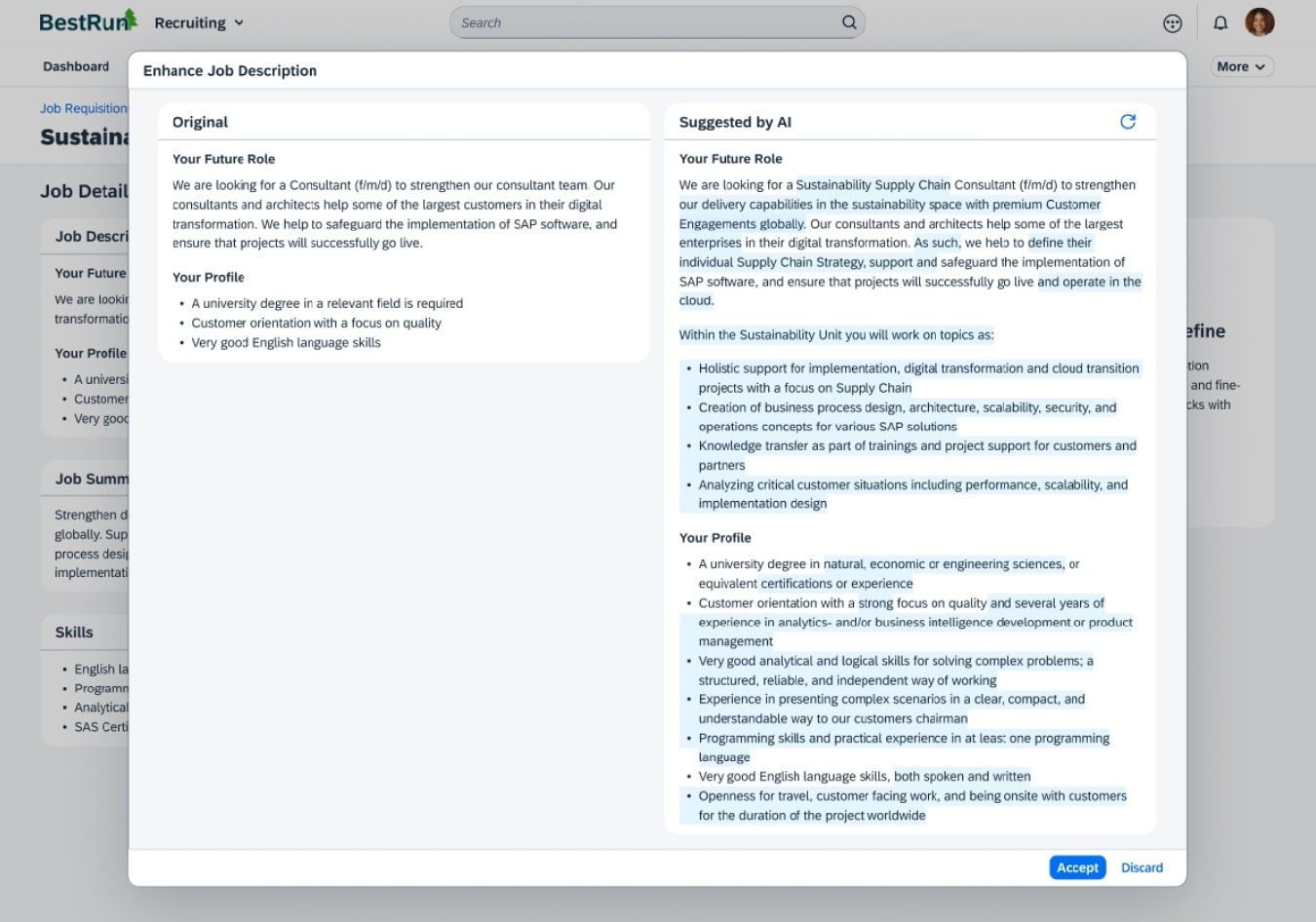
Another example is the use of Generative AI capabilities in SAP SuccessFactors Recruiting enables hiring managers to create compelling and accurate job descriptions that capture the desired skills and attributes of each role.

The possibilities to automate processes and gain predictive insights are endless with SAP’s intelligent suite of products. This demonstrates how SAP is enabling digital transformation through AI.
Strategic partnerships are accelerating SAP’s vision of infusing intelligence into organizations. SAP is collaborating with Google Cloud to integrate Google’s AI/ML technologies into SAP solutions and with IBM Watson.
This allows customers to run SAP systems and workloads seamlessly in the cloud while leveraging advanced analytics.
🚀 SAP has also invested in startups like Anthropic, Cohere, and Aleph Alpha that are pioneering generative AI.
By fostering an open ecosystem, SAP is shaping the future of enterprise software with leading-edge AI capabilities. Partnerships show SAP’s openness to expand capabilities.
The proof is in the pudding. SAP’s customers are already achieving business value from AI-enabled solutions.

Delta Air Lines is developing a generative AI proof of concept slated to automatically transform generic skill descriptions into more accurate capabilities that reflect the job’s requirements based on real-world, updated employee and customer data in context.
Retailers are optimizing promotions, and manufacturers are minimizing downtime. Across industries, SAP’s AI unlocks automation, prediction, and optimization that were unimaginable just a few years ago. These capabilities are embedded directly into SAP’s intelligent suite, from ERP to HR, enabling businesses to transform with minimal disruption.
Real-world examples make the benefits of SAP’s AI tangible.
To spearhead its AI strategy, SAP appointed Dr. Walter Sun as Global Head of Artificial Intelligence.
With over 25 years of experience at innovative companies like Microsoft and Amazon, Dr. Sun’s technical knowledge and business acumen are ideal to lead SAP’s AI efforts.
As AI adoption including generative AI gains momentum( see here for a point of view of how to use generative AI to revolutionize work productivity), SAP is poised to lead the way in enabling intelligent enterprises.
Several companies and new AI apps are helping businesses apply generative AI technologies in their business functions, from sales and marketing to customer support.
With ethical guidelines in place, SAP empowers customers to implement AI sustainably. By infusing AI across its solution portfolio and fostering an open ecosystem, SAP unlocks value across every business function.
Backed by real-world cases and expert leadership, SAP’s vision of intelligent enterprises is becoming a reality.
SAP’s multifaceted approach to enterprise AI sets it apart. With a holistic strategy spanning policies, products, partnerships, leadership, and investments, SAP leads the pack in responsible and cutting-edge AI.
It is also important to note that as LLMs grow, they will differ in how they address specific problems. This will help SAP’s customers get the best models to solve their unique problems.
As businesses increasingly embrace intelligence, SAP has built a formidable foundation to deliver business value at scale. The road ahead points toward unprecedented productivity and innovation as SAP continues to pioneer the intelligent enterprise.
Click here for my blog post on how SAP is making the Intelligent Enterprise a reality by infusing AI, automation, and intelligence into its solutions.
Artificial intelligence is transforming businesses across every industry. As a leading provider of enterprise software, SAP is at the forefront of leveraging AI to create intelligent enterprises.
In this blog, we’ll explore SAP’s AI initiatives and how they are enabling organizations to harness the power of AI.
With great innovation comes great responsibility. SAP recognizes that AI needs to be implemented ethically and has taken proactive steps to ensure this.
In January 2022, SAP’s Global AI Ethics Policy came into effect, providing guidelines for using AI responsibly.
SAP aims to empower customers to become intelligent enterprises in a sustainable manner. This shows SAP’s commitment to ethical AI, which builds trust with customers.
According to IDC, 🚀 60% of Forbes’ Global 2000 companies will expand their use of AI across key business functions by 2024.
SAP is making this achievable by embedding AI capabilities across its solutions portfolio. From marketing to finance, HR to procurement, SAP solutions enabled by machine learning can drive transformation across organizations.
For example, retailers can analyze sales data to optimize pricing and promotions. Manufacturers can predict equipment failures to minimize downtime.
Another example is the use of Generative AI capabilities in SAP SuccessFactors Recruiting enables hiring managers to create compelling and accurate job descriptions that capture the desired skills and attributes of each role.
The possibilities to automate processes and gain predictive insights are endless with SAP’s intelligent suite of products. This demonstrates how SAP is enabling digital transformation through AI.
Strategic partnerships are accelerating SAP’s vision of infusing intelligence into organizations. SAP is collaborating with Google Cloud to integrate Google’s AI/ML technologies into SAP solutions and with IBM Watson.
This allows customers to run SAP systems and workloads seamlessly in the cloud while leveraging advanced analytics.
🚀 SAP has also invested in startups like Anthropic, Cohere, and Aleph Alpha that are pioneering generative AI.
By fostering an open ecosystem, SAP is shaping the future of enterprise software with leading-edge AI capabilities. Partnerships show SAP’s openness to expand capabilities.
The proof is in the pudding. SAP’s customers are already achieving business value from AI-enabled solutions.
Delta Air Lines is developing a generative AI proof of concept slated to automatically transform generic skill descriptions into more accurate capabilities that reflect the job’s requirements based on real-world, updated employee and customer data in context.
Retailers are optimizing promotions, and manufacturers are minimizing downtime. Across industries, SAP’s AI unlocks automation, prediction, and optimization that were unimaginable just a few years ago. These capabilities are embedded directly into SAP’s intelligent suite, from ERP to HR, enabling businesses to transform with minimal disruption.
Real-world examples make the benefits of SAP’s AI tangible.
To spearhead its AI strategy, SAP appointed Dr. Walter Sun as Global Head of Artificial Intelligence.
With over 25 years of experience at innovative companies like Microsoft and Amazon, Dr. Sun’s technical knowledge and business acumen are ideal to lead SAP’s AI efforts.
As AI adoption including generative AI gains momentum( see here for a point of view of how to use generative AI to revolutionize work productivity), SAP is poised to lead the way in enabling intelligent enterprises.
Several companies and new AI apps are helping businesses apply generative AI technologies in their business functions, from sales and marketing to customer support.
With ethical guidelines in place, SAP empowers customers to implement AI sustainably. By infusing AI across its solution portfolio and fostering an open ecosystem, SAP unlocks value across every business function.
Backed by real-world cases and expert leadership, SAP’s vision of intelligent enterprises is becoming a reality.
SAP’s multifaceted approach to enterprise AI sets it apart. With a holistic strategy spanning policies, products, partnerships, leadership, and investments, SAP leads the pack in responsible and cutting-edge AI.
It is also important to note that as LLMs grow, they will differ in how they address specific problems. This will help SAP’s customers get the best models to solve their unique problems.
As businesses increasingly embrace intelligence, SAP has built a formidable foundation to deliver business value at scale. The road ahead points toward unprecedented productivity and innovation as SAP continues to pioneer the intelligent enterprise.
Click here for my blog post on how SAP is making the Intelligent Enterprise a reality by infusing AI, automation, and intelligence into its solutions.

 SAP is leading the charge in helping organizations leverage the latest technologies to transform into intelligent enterprises.
With a suite of solutions tailored to industries, SAP allows companies to optimize operations, gain insights, and prepare for the future.
This article explores how SAP drives innovation today and empowers future-ready business reinvention.
At the core of SAP's approach to digital transformation is artificial intelligence (AI) and machine learning. Integrating AI capabilities allows SAP to embed intelligence directly into business applications:
These innovations optimize processes across manufacturing, supply chain, finance, marketing, HR, procurement, and more.
For example, AI improves production in smart factories, provides insights to adapt supply chains, automates accounting tasks, and streamlines HR operations. Learn more about SAP's approach to AI.
SAP builds intelligence into cloud solutions purpose-built for industry needs:
SAP provides AI models developers can integrate to add intelligence to applications:
With new technology comes responsibility. SAP takes an ethical approach to AI according to internal guidelines that cover:
This focus on trust and ethics is crucial as technology integrates deeper into business processes. Learn about SAP's commitment to AI ethics.
SAP Business AI brings together SAP's integrated intelligent technologies and applications in an end-to-end offering. Key components include:
With comprehensive capabilities that span applications, data, infrastructure, and services, SAP Business AI enables organizations to become intelligent enterprises.
In addition to AI, blockchain, and IoT, SAP continuously evaluates emerging technologies with transformative potential:
Generative AI leverages models like DALL-E 2 to create content with natural language prompts. By automating repetitive tasks, generative AI can boost productivity and creativity. See how SAP applies generative AI.
Metaverse technologies enable collaborative 3D virtual environments for remote work, training, design, and simulation. The metaverse unlocks new ways to engage customers and employees. Learn about the metaverse.
Web3 like blockchain explores decentralized models powered by trust, transparency, and collaboration. However, it will take time to develop Web3 for enterprise adoption. Explore the future of work with Web3.
Blockchain brings increased transparency, traceability, and automation to supply chains, transactions, and data sharing. By integrating blockchain capabilities, SAP enables more trust, visibility, and collaboration:
With blockchain, SAP customers can enhance supply chain integrity, contract management, product provenance, and more. See how blockchain works.
The Internet of Things (IoT) allows organizations to harness data from connected devices and assets to gain real-time visibility and insights. SAP provides an enterprise IoT platform with integrated monitoring, analytics, and automation:
IoT creates a digital feedback loop to improve safety, sustainability, efficiency, and innovation. Discover the foundations of IoT.
By continuously innovating, SAP augments its solutions to help businesses adapt and succeed.
With solutions tailored to industries powered by emerging technologies, SAP enables organizations to transform into intelligent enterprises. The benefits are far-reaching:
As a leader in enterprise software, SAP leverages the latest innovations in AI, machine learning, blockchain, IoT, and more to help organizations become intelligent enterprises.
SAP Cloud solutions built for industries enable companies to optimize operations, engage customers, and adapt quickly to the future.
With a focus on ethics and security, SAP delivers trusted AI capabilities integrated into the applications businesses rely on.
By partnering with SAP, companies can drive digital transformation and harness the full potential of intelligent technologies.

The age of artificial intelligence is here. AI has exploded in capability and accessibility, with powerful tools now available across every business function.
In this comprehensive guide, we reveal the best AI tools spanning key categories like productivity, marketing, design, education, and more.
These leading AI apps leverage innovations in natural language processing, generative learning, and neural networks delivering game-changing capabilities to take your business to the next level:
✅ Writing and content creation
✅ Data analysis and visualization
✅ Automated workflows and processes
✅ Customer engagement and sales
This definitive guide will explore the top AI tools you need to grow your business. Let's dive in.
Supercharge productivity by offloading repetitive tasks to AI. These tools help you save time on writing, research, data entry, and more.
Empower your team with solutions like Albert, Copy, Rytr, and Shortly.
Automate workflows with Otter.ai, Descript, and Fireflies.
ChatGPT, Bard, and Claude offer a versatile generative AI assistant.
Optimize enterprise knowledge with tools like Mindscape and Speechify.
Make data-driven decisions with solutions like Optimove and Persado.
Boost sales with AI chatbots Drift and Conversica.
Find new opportunities with trend analysis from Exploding Topics and Trend Hunter.
Promote your brand with Post Intelligence and Promo.com.
Engage students with AI tutors like Anthropic and course creators like Quizlet.
Make coding fun with Erase All Kittens.
Otter.ai also enhances lectures through speech-to-text notes.
TextHelp assists those with reading and writing difficulties.
Discover new ways to learn with EdApp microlearning and knowledge boosters like Otus.
Unleash creativity with AI-generated art, images, logos, and videos.
Solutions like DALL-E 2, Midjourney, and Looka make design easy.
Build websites with Studio and Uncody. Create videos with Synthesia. Design resumes with KickResume.
Remix creativity with Aiva's AI music and Boomy's track generator. Explore AI art like NightCafe and Wombo.
Delight users with face swaps from Reface, songwriting via Jukebox, and stories from AI Dungeon.
The AI revolution offers limitless opportunities to streamline operations, wow customers, and accelerate growth.
But with hundreds of tools now available, it can be challenging to know where to start. See here for how SAP is making AI accessible for Businesses.
This guide covers the leading AI tools making an impact across key business functions.
Look for tools aligned with your specific pain points and processes.
Carefully evaluate free trials and paid plans to choose the best options.
Focus on integrating AI into existing workflows for maximum impact. With the right strategy, these intelligent tools will transform your business (see an example of how prompt engineering can help your organization).
The future is here. Harness the power of Generative AI and automation to work smarter, gain competitive advantage, and create incredible value.